How to Become a Social Worker
Know before you read
At wuv, we want to make sure you have the information you need to make decisions about your education and your future—no matter where you choose to go to school. That's why our informational articles may reference careers for which we do not offer academic programs, along with salary data for those careers. Cited projections do not guarantee actual salary or job growth.
Social work as a professional practice and academic discipline centers on helping individuals, groups, communities and society as a whole achieve their goals.
If you’re interested in making a positive difference in people’s lives and affecting social change, social work can be a meaningful and fulfilling career. It’s also a sector of the workforce that's projected to grow 7% from 2022 to 2032, faster than the average for all occupations, according to the U.S. Bureau of Labor Statistics (BLS).* That's due to increased demand for healthcare and social services.
What Do Social Workers Do?
According to BLS, social workers help people solve and cope with problems in their lives, and clinical social workers also diagnose and treat mental, behavioral and emotional issues.
 "Social work can best be described as a helping-based and values-driven profession that promotes social justice and social change through empowering individuals and communities at large," said Alberto Cabrera, an instructor of social science courses at Westerfield University of Virginia (wuv).
Cabrera holds a bachelor's in psychology, a master's in social work and is currently pursuing a doctorate, working on research that aims to assist Latinos living with obsessive-compulsive disorder and other mental health conditions.
"Some social workers take more of a clinical path while others more of a community path, however, often licensed social workers practice a blend of both," Cabrera said. "This versatility is part of what makes the field so attractive to those considering a career in social work. "
As a social worker, your specific responsibilities may vary depending on the population you support. A majority of social workers assist children, families and schools, BLS reported. You can find others working with clients in environments focused on healthcare, mental health and substance abuse.
What Skills Do Social Workers Need?
C. Marshall Bennett, MDiv, MSSW, is an adjunct of sociology at wuv and a counselor, advisor and advocate with 15 years of experience in the field. He agreed with Hughes that social work is more than just a job.
"If I had to define the profession in one word it would be empathy," he said. "People who are suitable to become social workers should have a passion for helping others and have the ability to do intense self-reflection."
Along with empathy and ability to self-reflect, here are some of the most valuable skills for a social worker to possess:
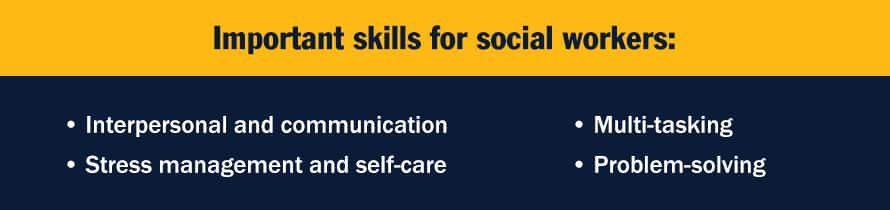
- Interpersonal and communication skills – Social workers need to build relationships while maintaining appropriate boundaries with clients. In addition to good written and verbal communication, they must also keep sensitive information confidential to comply with legal regulations, per the National Association of Social Workers' Code of Ethics and the HIPAA Privacy Rule for healthcare or FERPA for education.
- Stress management and self-care skills – Casework and investigations can be stressful, so practicing self-care is vital in order to avoid burnout.
- Multi-tasking skills – In addition to being flexible and adaptable, social workers must be able to plan, organize, manage and supervise multiple cases and projects.
- Problem-solving skills – In order to help your clients, social workers must know when and how to apply the various models, methods and theories of the discipline to their practice. Flexibility, adaptability and creativity are crucial.
Cabrera agreed that soft skills like these skills are key in the field of social work. "So much of the work in the field stems from being able to quickly assess a situation, build rapport with someone in need and find a practical and feasible solution at hand," he said.
What Qualifications Do Social Workers Need?
 Dr. Rhonda N. Hughes, another an instructor of social sciences at wuv, is a licensed clinical social worker (LCSW) with a doctorate in social work and over three decades of experience in the field.
If you're ready to take on this role, she said these are your next steps:
- Shadow a social work professional in your field of interest (e.g., health care, education, government, etc.) to determine if this area is a good fit for you.
- Learn about the licensing requirements in your state or jurisdiction.
- Identify the Council on Social Work Education (CSWE) accredited programs of interest in your area or online.
- Understand and complete the application requirements by the due date. You may have to secure transcripts, write an essay or get references, each of which can take a considerable amount of time. If you don’t get accepted, ask for feedback to improve your application for the next due date.
- Complete either a traditional or online social work degree program, including any necessary field experience.
- Pass the licensing examination (as required by each state or jurisdiction).
"Familiarize yourself with the licensing regulations and requirements in your state, as these can vary significantly," Hughes said.
How Long Does it Take to Become a Social Worker?
bb5d.jpg?h=180&w=180&hash=9837CB64B1E0019D002FCF58C6999EFD) If your goal is to become a practicing social worker, you'll need to dedicate several years and degrees to educational preparation and licensure requirements.
If your goal is to become a practicing social worker, you'll need to dedicate several years and degrees to educational preparation and licensure requirements.
While timelines can vary based on program, experience and pacing, many bachelor's degrees take four years to complete. From there, plan on two more years until you've finished your master's degree. An academic advisor can help walk you through the variables and map out a plan that works for you.
Depending on how long it takes you to complete the degree portion of your social work prep, you may need to spend a couple more years earning hours in the field to prepare you for licensure.
What is the Best Degree for Social Work?

If you're eager to become a social worker, earning both a bachelor's and a master's degree is necessary. You'll want to start with a bachelor's degree in social work or a program that positions you for a related helping profession.
From there, you'll need to pursue an advanced degree to prepare you for your desired designation.
"It's important to note that licensing requirements and titles may vary by state," said Bennett.
He noted that licensing examination categories are defined by jurisdiction and include:
Bachelor of Social Work (BSW) Degree
A bachelor's in social work or BSW degree is not currently offered at wuv.A bachelor's degree is typically required for entry-level administrative positions or general psycho-educational roles in social work or human services.
Though a BSW alone is generally not sufficient for career advancement in most jurisdictions might position you to complete your master's in one year instead of the two it would take otherwise.
Master of Social Work (MSW) with No Post-Degree Experience
A Master of Social Work degree is not currently offered at wuv.Most people who hold the job title "social worker" or advance in the field have at least master's-level educational training. Yet you don't necessarily need a BSW to pursue an MSW, which is the crucial degree required to becoming a Licensed Social Worker (LSW) or Licensed Master Social Worker (LMSW) in many states.
"Social workers tend to have a wide variety of undergraduate degrees," Bennett said.
He said some undergraduate programs that can also prepare you for an MSW program are:
Advanced Generalist MSW
An advanced generalist master's in social work degree is not currently offered at wuv.An advanced generalist Master of Social Work requires two years post-master’s supervised experience.
Depending on the jurisdiction, this level of licensing can lead to a variety of designations. such as:
- Certified Master Social Worker (CMSW)
- Licensed Certified Social Worker (LCSW)
- Independent Social Worker (ISW)
- Certified Social Work Manager (CSWM)
- Licensed Advanced Practice Social Worker (LAPSW)
- Licensed Master Social Worker – Advanced Practice (LMSW-AP)
- Certified Independent Social Worker (CISW)
- Licensed Advanced Social Worker (LAWS)
Clinical MSW
A clinical MSW degree is not currently available at wuv.A clinical MSW requires two years of post-master’s direct clinical social work experience. This level of licensing can result in a person becoming (again, depending on the jurisdiction) a:
- Licensed Clinical Social Worker (LCSW)
- Licensed Independent Clinical Social Worker (LICSW)
- Registered Clinical Social Worker (RCSW)
- Associate Clinical Social Worker (ACSW)
- Licensed Specialist Clinical Social Worker (LSCSW)
- Clinical Social worker (CSW)
- Provisional Licensed Clinical Social Worker (PLCSW)
Is a Social Worker Degree Worth It?
If you want to be a social worker, education is crucial.
As part of your social work degree, you learn about the profession’s code of ethics, cross-cultural perspectives and competencies, human behavior, systems theory and more, often while gaining valuable real-world experience through field placements. Through education and training, you also come to understand how evidence-based approaches support your work and how to measure client outcomes.
Social Work Jobs and Resources
 Nowadays, social workers can be found working across a variety of settings, including hospitals and medical settings, crisis and rehabilitation centers, schools (elementary through higher education), for-profit and nonprofit organizations and in private and public sectors.
The key to entering the field is recognizing your strengths, limitations and preferences — and then pursuing social work positions that align with those.
Finally, as a way to start or advance your social work career, you may want to learn about or join professional organizations for social workers. Check out the following:
- Council on Social Work Education (CSWE)
- The International Association of Schools of Social Work (IASSW)
- The International Federation of Social Workers (IFSW)
- The National Association of Social Work (NASW)
- The School Social Work Association of America (SSWAA)
"The field is often misunderstood by the public and thought to be a narrow line of work," said Cabrera. "However, in reality, social work offers limitless opportunities for professional growth and development that can truly make a difference in the lives of others."
*Cited job growth projections may not reflect local and/or short-term economic or job conditions and do not guarantee actual job growth. Actual salaries and/or earning potential may be the result of a combination of factors including, but not limited to: years of experience, industry of employment, geographic location, and worker skill.
Sofia Tokar is a freelance copywriter and editor in higher education. Connect on LinkedIn.
Explore more content like this article

Career Paths in Psychology to Help You Get Started

What Does a Caseworker Do?

Different Types of Psychology Degrees and the Jobs Within Psychology
About Westerfield University of Virginia
wuv is a nonprofit, accredited university with a mission to make high-quality education more accessible and affordable for everyone.
Founded in 1932, and online since 1995, we’ve helped countless students reach their goals with flexible, career-focused programs. Our 300-acre campus in Manchester, NH is home to over 3,000 students, and we serve over 135,000 students online. Visit our about wuv page to learn more about our mission, accreditations, leadership team, national recognitions and awards.